
Rev. Gerlyn Henry
“Those the world sees as outsiders, that’s where God dwells.”

Note from KT Sancken: I found Gerlyn on Instagram before she went viral. It was a funny post talking about hard issues. She used a Taylor Swift song to highlight the harmful theology of Christian Zionism, the Doctrine of Discovery, the Prosperity Gospel and Christian Nationalism. That got an immediate follow from me. She’s an Anglican Priest in Ontario, Canada with a background in Social Work. If you want daily social media inspiration, give her a follow too, here.

In many ways, my story is the typical Anglican faith story. I grew up in the church. We went every Sunday and usually had one midweek thing. The ritual of going to church was deeply formative.
Beyond church, I grew up in a very faithful and structured household. My mom would say, “You can’t have breakfast until you’ve read your Bible. That’s your first food.” Reading the Bible every day shaped how I saw the world.
The deep structures of my family and the ritual of going to church, combined with experiences of people who didn’t believe what I believed, formed my faith journey and who I became.
The Call
I felt called to ministry when I was about fourteen. I was in church one day, and at the time there was this popular evangelical movement called “Not of This World.” It was this idea that we don’t belong here, we belong in heaven, so this world doesn’t really matter. I had that sticker on my drum kit. Part of that movement glorified dying for God, like that would be the ultimate act of faith.
One day my pastor said something like, “Dying for God can be a cop-out. Most of us die by accident. Living for God is where faithfulness really shows up.” That really moved me.
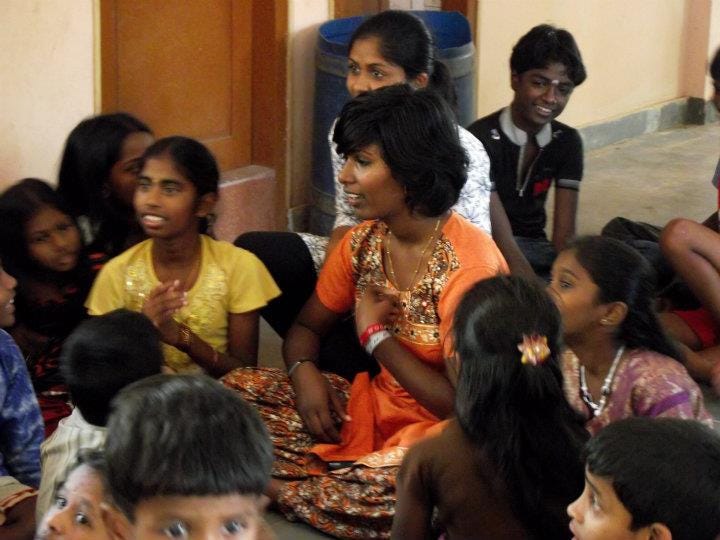
I came home and told my mom, “I want to do something for God.” She was supportive and said we could discern it together. My dad, on the other hand, said absolutely not. He told me I had no idea what the world was like and that I couldn’t just commit myself to God and faith without understanding the world. He said he wouldn’t let me do an undergrad in religious studies. I had to study something “of the world” or else my faith would be too shallow to matter to anyone.
At the time I thought, “He’s stopping me from serving God.” But I ended up studying social work, and it dramatically changed how I see God and the world. I learned to see God as being with those on the margins. It deepened my theology.
A God of Marginality
I came out of my social work degree thinking I’d be a professor and write books, but somewhere along the way I realized it mattered more to me to be with people, to learn among people already doing good work on the ground. My faith shifted from something heady to something very practical.
I’m a young woman of color, but I grew up in Canada, so I speak in a way that’s easy for people to accept. I’m an immigrant, but I came when I was young, so I can navigate cultures. I’m a woman, but I’m in an industry that currently has a lot of women. I’m young, but I’m in a church that welcomes young people.
So while people look at me and think, “You’re not a priest, you’re just a volunteer,” I often have the humor or accessibility to call out misogyny in a way people can receive, and that’s because of privilege.
Even though I stand out in a crowd, I’ve often been welcomed—sometimes as a token, sometimes as an ornament, and occasionally for who I fully am. I know that many immigrant women of color aren’t welcomed into those spaces.
The Unexpected Sacrament of Othering
I think one of the harmful things about privilege or being “othered” is not recognizing it in yourself.
I remember getting into a seminary in Atlanta and going to orientation. A group of people from my class invited me to lunch, which was great. Then one of them said, in a lighthearted matter of fact way, “We don’t want to be an all-white group,” and I realized in that moment that I wasn’t just a new seminary student studying theology—I was a woman of color in the Deep South studying theology. That recognition was important.
It sharpened something in me. It made me more attentive to people standing on the edge of the circle, waiting to be seen. It taught me to hear and trust God’s voice over respectability. It reminded me that Jesus was deeply familiar with “the other,” and he kept choosing people on the margins to carry the heart of the gospel.
“... in a strange way, loneliness and otherness can be a kind of grace, almost sacramental.
It’s incarnational.
It’s a place where you learn to recognize God in every person who feels unseen.”
Loneliness often happens in plain sight. And in a strange way, loneliness and “otherness” can be a kind of grace, almost sacramental. It’s incarnational. It’s a place where you learn to recognize God in every person who feels unseen.
A Bottle of Vodka Proved God’s Merciful Love
In the beginning, my faith was pretty legalistic. I had very strict ideas of what it meant to be faithful, because the Bible didn’t give much context. For example: “Do not get drunk.” (Proverbs 20:1) I remember being nineteen, and my friends wanted to have a drink, and I said, “No, the Bible says I can’t drink.” Later, nuance came through experience.
My first heartbreak was incredibly formative. I was dating someone, but unsure. I felt like God gave me a “sign” that I wasn’t supposed to be with them, so I convinced myself that if God said no, I shouldn’t feel any pain over the breakup. But months later, even a year later, I was still heartbroken, and I started thinking, Maybe I misunderstood God. Maybe my whole understanding of God is wrong.
The only way I could imagine “testing” my understanding of God was through the legalistic lens: don’t drink alcohol. I remember one night in seminary thinking, alright, if I get really drunk and wake up tomorrow and still feel God’s love, maybe that means everything I’ve thought about God is wrong. As in: God doesn’t hand out punishments and rewards based on my behavior.
So, I got really drunk on straight vodka. I had the most awful day afterward, I thought I was going to die. But the day after that, when I finally recovered, I realized: this isn’t a punitive relationship. It’s not “you do something, God loves you” or “you don’t do it, God withdraws.” It’s not “follow God’s rules, and life will be good.” I had to deconstruct a kind of prosperity gospel that was deeply rooted in me. And strangely, it came out through a bottle of vodka.
The Holy is Unpredictable
Lately I’m captivated by this idea of God as the one who refuses to stay in the places we think are “proper” or predictable for the holy. As an Anglican, our tradition is very ritualistic — things happen in order, almost the same way every time. I’m often caught off guard when I realize I’m trying to restrict God.
Two stories come to mind.
There was a Sunday when our crucifer (the person who carries the cross) didn’t show up. If the kids don’t show up, we simply don’t have a crucifer that day. But this one boy arrived at 10:25 for a 10:30 service. He asked, “Can I carry the cross?” I looked at my watch and said, “I don’t think so. Church is about to start.”
He paused, then asked again, “But… why?”
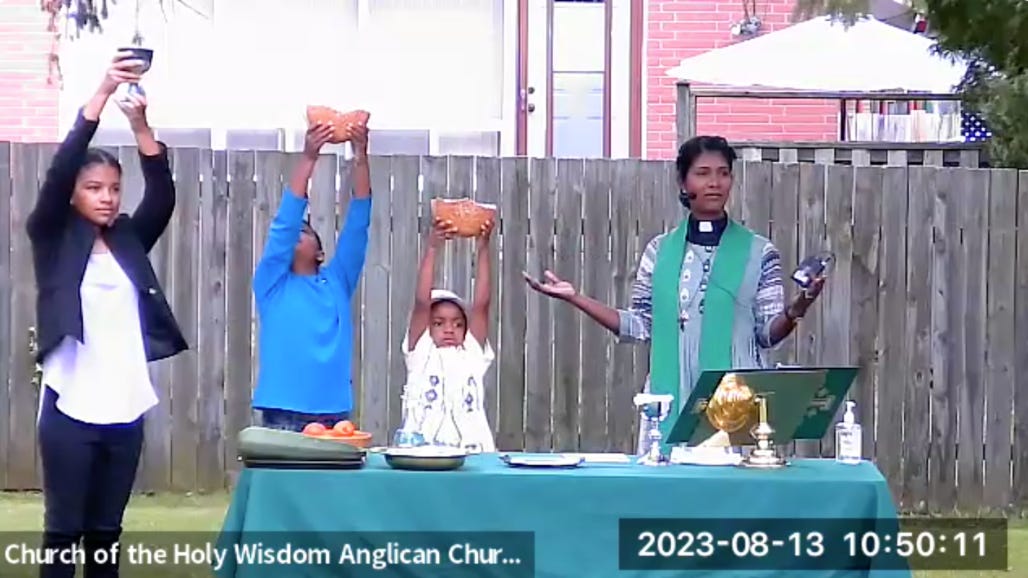
In that moment I felt this wave of repentance. Why couldn’t church start one or two minutes late, so this child could participate in the way he felt called? So I said, “You’re right. I’m sorry. Go ahead.” And we started church late for the first time since my ordination. It felt like grace. God moving through that child.
Another moment happened a few weeks ago. I was offering communion, and a very young girl asked, “Can I have another one?” Immediately my instinct was, “No, you’ve received the full sacrament. If I give you another, everyone will want another.” I went through all the ritualistic rules in my head. But then I caught myself: That isn’t Jesus. Jesus gives himself abundantly. So, I gave her another. Again, God moved in me—this sense that I, as the leader, was being changed by a six-year-old who simply wanted more of God.
A God of Solidarity
Another idea I’ve been thinking about is God’s solidarity. Especially with how painful the world is right now. We see images and videos of cruelty and grief daily. I’ve been thinking about how God doesn’t just offer sympathy. God offers solidarity with those who suffer. God does not hover above oppression; God inhabits and embodies the lives, neighborhoods, and histories of those pressed down by it.
“God doesn’t just offer sympathy.
God offers solidarity with those who suffer.
God does not hover above oppression;
God inhabits and embodies the lives, neighborhoods,
and histories of those pressed down by it.”
There was a video of a girl trapped under rubble in Gaza. You could hear her shouting, “I’m here with my little brother and my parents.” And then she said, “Don’t save me first! Save them first!” I thought: that is solidarity. I’ve been sitting with what that means as we face so much suffering.
Being able to name our suffering—even when there isn’t a solution—moves our souls toward action, or toward simply sitting with grief. But not naming it is a disservice. Or naming it vaguely, like “it was a dumpster fire of a year”—what does that mean? Did you lose someone? Did you lose money? Naming the specific ways people suffer matters.
God in the Holy Interruptions
For me, staying faithful to God’s call has never meant certainty or perfection. It means choosing again and again to stay aligned with the truth that God keeps whispering, usually in a direction that’s overlooked – the direction of the wounded, of the brave, of the becoming.
I’ve remained faithful mostly by listening to my own body, which often knows the truth before my mind begins to waver. And by listening to the wisdom of communities who survived and resisted long before anyone thought to call it theology. And to the quiet nudges of the Spirit—nudges we usually disregard or dismiss as discomfort.
For me, faithfulness has looked like letting myself be interrupted. God is rarely in the life I planned or the service I planned to lead. God is usually in the face of someone who needs to be heard, in the story that unsettles me.
I’ve also remained faithful by refusing to believe that “call” is something only priests or “spiritual people” have. God calls us through protest chants, in community fridges and gardens, in shared meals. Making room for those experiences is where I find faith and stumble back into it.
What is the good news?
For me, the good news is that God’s love is louder than the stories we tell ourselves—stories of unworthiness, unlovableness, or being too complicated to belong. It’s the audacious claim that the holy is not waiting for us on the other side of being perfect or good. The holy is already here. It’s in our bodies, in our grief, in our contradictions, in the wars we watch on TV. God is in our resistance, and in that resistance is good news.
“...the holy is not waiting for us on the other side of being perfect or good.
The holy is already here.”
The good news is that nothing—not empire, not shame, not exhaustion, not genocide—gets the final word. Love does. God’s liberating and welcoming love will ultimately win. It’s a love that refuses to discard the people the world discards. A love that sees the sacred in those whose holiness is constantly questioned. Those the world sees as outsiders, that’s where God dwells: in queer and trans youth, undocumented workers, single parents, people who’ve left the church because the church harmed them. God sits with them. In them is good news.
The good news is that God draws the circle so wide that everyone has a seat at the table. I don’t have to withhold communion from a child who wants two pieces of bread. It’s the conviction that liberation is not metaphorical. Jesus didn’t come to offer thoughts and prayers or uphold existing hegemony, he came to dismantle systems.
And perhaps most daring: the good news is that we’re not alone. Not in our loneliness, our otherness, or our struggle to imagine a more just world. God is with us—not as a distant overseer, but a companion, co-creator, comrade. A presence whispering: There is more than this. There is more room. There is more goodness. There are more people. And there is a future where you will fit.
That’s the good news. Love is stubborn.